Remembering Richard, and The Last Plantagenet?

Despite the current situation with coronavirus causing events to be cancelled this year, the end of March is an important one now, for Ricardians. As well as remembering birth, death, marriage, coronation, we can also mark reburial. Five years ago, all eyes were on Leicester, as one of England’s most famous kings was laid to rest for the second time.

And one of our authors was lucky enough to be there for part of it. So, for Jennifer’s first post in our regular series taking place on the Ocelot Press blog, do forgive a bit of indulgent personal nostalgia, and tell you a bit about the beginnings of The Last Plantagenet?

LeicesterUni-CoffinAtUni

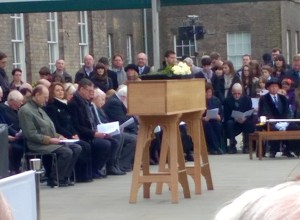
When I put my name into the ballot for a place at one of the events that week in Leicester, I only did it to say I had, to be a part of things, but then, then arrived the envelope… I was going to Compline, the service during which the coffin of Richard III would be brought into the cathedral. And more than that – there was a full Saturday of lectures to attend, and the particularly moving service on Sunday morning at the University of Leicester itself, as they bid farewell to the remains they had studied so carefully, and preserved so well, since they found him in that carpark. Walking down the street behind the hearse for a few moments was a very strange sensation, then heading back to my hotel room and watching the rest of its journey on the BBC news channel.

JCW in Leicester Cathedral

It was a beautiful day all round, and being in Leicester Cathedral to watch the service of Compline is something I shall never forget. There was an odd sense to the day. Yes, it was a funeral, so of course everyone was suitably respectful and sombre in their attitude, but equally, although people had hoped to find King Richard III, it’s not as though anybody was expecting to find him alive, so there was also a sense of celebration to things.

They were even letting people take photos, once the service was over.

That night, after strolling back from the cathedral through the rose-strewn streets of Leicester, I sat in the hotel bar (the smartest-dressed Travelodge clientele I have ever seen!), and pulled out the notebook I’d had in my bag all weekend. I had been playing with an idea for a while, a timeslip novella featuring Richard III, but however hard I tried, couldn’t make it ‘work’. Sitting there, absorbing everything that had happened over the two days, the words flowed. I got my ending, and other than some minor tweaks, the plot was sorted!

The Last Plantagenet? was born… 

CoffeePotBookClubReviewGraphic-TLP

It’s had an exciting journey, first being self-published in October 2017, then joining Ocelot Press in October 2018. And I was thrilled to bits when it was awarded not only a five-star review from the Coffee Pot Book Club Award, but also an Honourable Mention in the blog’s 2019 Book of the Year Awards.

CoffeePotBookClubAward-2019TimeTravelHonMention

Special Offer!

To celebrate the fifth anniversary of this important event, and the night I can pin-point as the start of when everything starting happening for me, writing-wise (I got back and began editing my Kindred Spirits series too!), The Last Plantagenet? ebook is free to download for a limited time.

I hope you enjoy reading it as much as I enjoyed writing it!
Going Back in Time: Creating a Sense of Place in Fiction

In our continuing series of weekly blog posts, Ocelot author Vanessa Couchman tells us about her research process.

For all historical novelists, research is a vital part of the writing process. Since I took a degree in history, I enjoy the research part enormously. The danger for me is getting so carried away with the research that it threatens to take over the writing!

Continue reading “Going Back in Time: Creating a Sense of Place in Fiction”

Serendipity and Discovery

This post is by Nancy Jardine

When I’m writing my Celtic Fervour Saga Series, set in late 1st century Roman Britain, I depict a reality that my readers can immerse themselves in and totally relish. A 2019 review of Book 1 included: “The descriptions of the people, places, tribes etc are phenomenal – I literally felt like I was there.” Comments like these are absolutely delightful and tell me that what I strive for is well-appreciated.

Award Winning – Celtic Fervour Saga Series

Since written evidence for late 1st century Roman Britain is so scant, more than a quick dip into archaeology is needed, and other sources also help with world-building. Scientific disciplines like soil culture, land erosion, natural plant and animal habitats assist with describing the landscape of 2000 years ago – because, to me, it’s wrong to put characters of Roman Britain into the fields and farms of the 21st century and call it historical fiction.

However, I also acknowledge that what I write comes from speculative information. An archaeologist digs out an artefact from a situation, takes care to detail its surroundings, but what happens after that is his/her interpretation of its use in society. Since beginning the writing of my series in 2011, I’ve discovered a recent archaeologist interpretation of a historic site may differ from an interpretation of the 1970s. Both of those may also be quite different from those of the earliest historians and ‘hobby archaeologists’, from the Medieval era onwards (before archaeology was a proper scientific study with documented procedures).

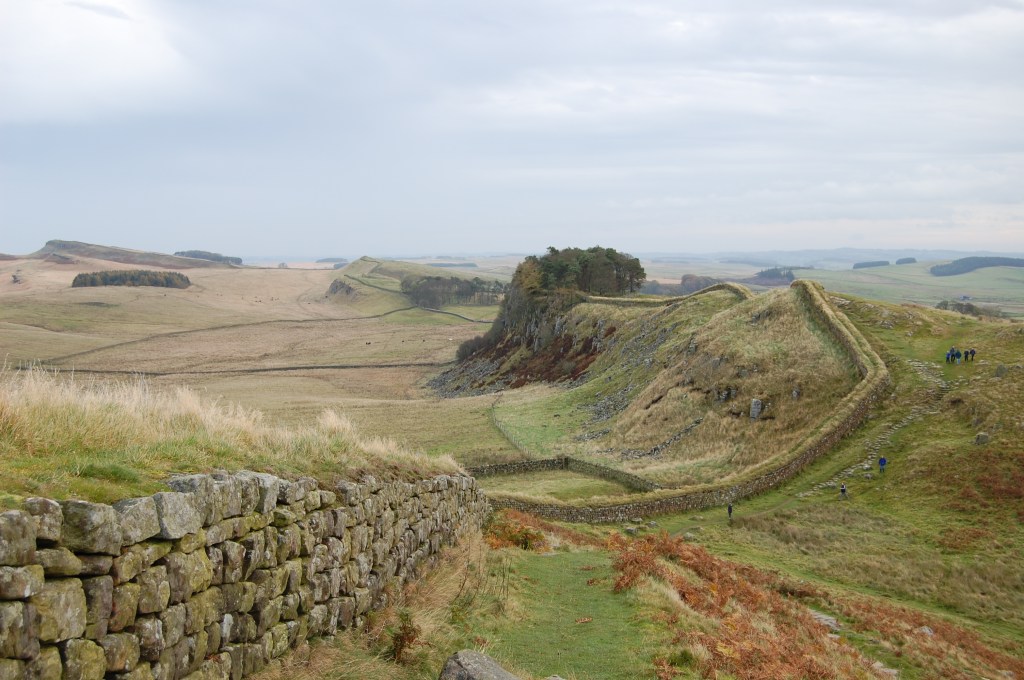
https://commons.wikimedia.org/wiki/File:Hadrian%27s_Wall_west_of_Housesteads_3.jpg

I love reading that evidence uncovered four or five centuries ago is being given a new examination because the very early investigators were sometimes a little bit off the mark. A glaring example might be that, for a while, it was thought that the c. 73 miles of stone wall, which extends across the north of England, was built by Ancient Roman Emperor Septimius Severus. Severus’ Wall? I can see lots of heads negatively shaking right now! That opinion was formed by some of the early classical scholars who relied on translating the scant written texts available to them, in conjunction with studying some artefacts unearthed in the area. It was only after a lot more physical evidence was gradually uncovered that Emperor Hadrian was given the glory for being such an incredible frontier builder. Emperor Severus WAS in the Hadrian’s Wall area during his Caledonian campaigns of c. A.D. 210, but by then the wall had existed for around 90 years.

Now, it seems that almost every day, there’s new information on social media about artefacts uncovered from the forts and settlements that peppered Hadrian’s Wall. I’m heartily glad that we now get an almost daily update on archaeological digs, and it’s really exciting when we get glimpses of the evidence before they are cleaned. Even better is when I see daily webcam footage of ongoing archaeological investigations!

Trimontium Museum, Melrose – Nancy Jardine

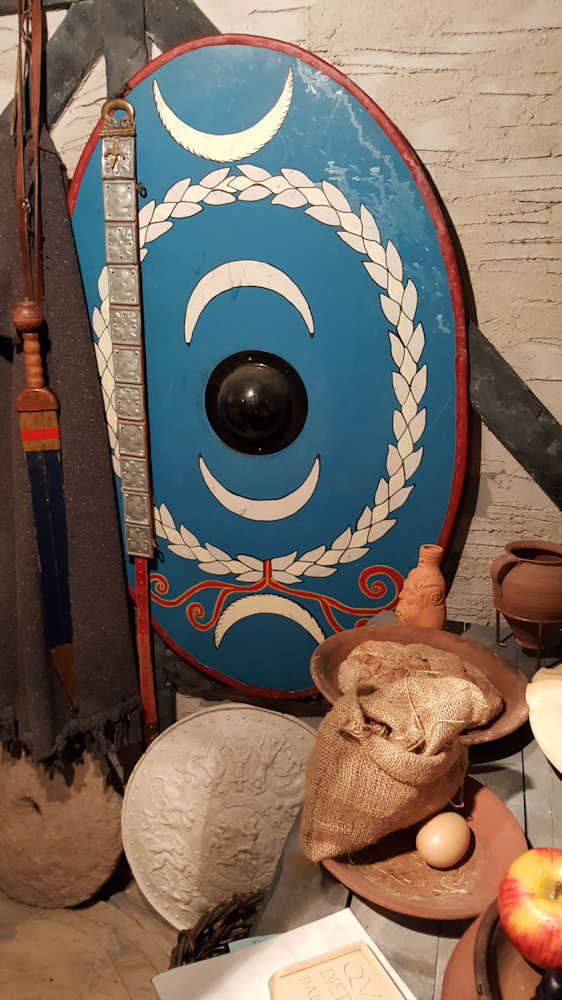
In late 2018, I visited a wonderful little museum in Melrose, in the Scottish Borders, run by the Trimontium Trust – though it’s currently closed to visitors and under expansion. When re-opened, its upgrade will make it mirror the typical museum style of the 21st century and in some ways, this saddens me. When I visited the one-roomed museum, it was literally crammed to the ceiling with evidence collected from the nearby Trimontium Roman Fort (Newstead Roman Fort) and wonderful reconstructions of what life might have been like at Trimontium during the few centuries of fort occupation. I hope the new museum will still have a similar tactile and visual impact. The most recent excavations indicate that the area housed multiple successive forts with adjacent temporary camps – the Romans adept at dismantling a building, levelling the ground, and rebuilding over the top. The downside being that process makes it difficult for archaeologists to asses the layouts of the earliest Flavian forts, especially the one which my characters would have inhabited.

Trimontium Museum, Melrose -Nancy Jardine

Trimontium Roman Fort, named for the three peaks of the Eildon Hills behind it, was situated at a crossing of the River Tweed where the Ancient Roman Road we refer to as Dere Street wended its way northwards. Trimontium was therefore an important, strategic fort on the main route north/south and, unlike many forts in Scotland, had longer periods of use than some others.

reconstructed Parade Helmet and Mask – Trimontium Fort, Melrose – Nancy Jardine

The evidence collected at Trimontium has been astounding, as has that of another location on Hadrian’s Wall named Vindolanda Fort. I expect to be writing at length on my own blog about Trimontium and Vindolanda…not to be mistaken with Vinovia, which is yet another fort on Dere Street and not so far away from the ‘wall’

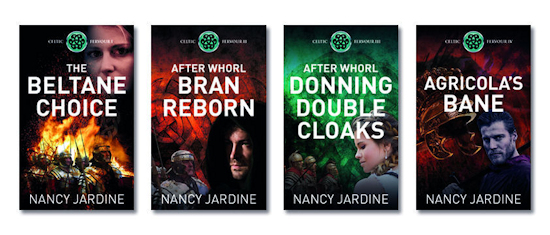
All of these forts feature in Book 5 of my Celtic Fervour Saga, expected to be published later in 2020 when I complete the stories of General Agricola, Beathan the Brigante and my Garrigill Clan.

Ocelot Press novels are all well-recommended, wonderful tales. Whatever you may be reading – enjoy the experience!

For the link to Nancy Jardine’s Author Page on amazon click HERE . All novels are available in #KindleUnlimited and paperback versions are available to order/buy at bookstores.

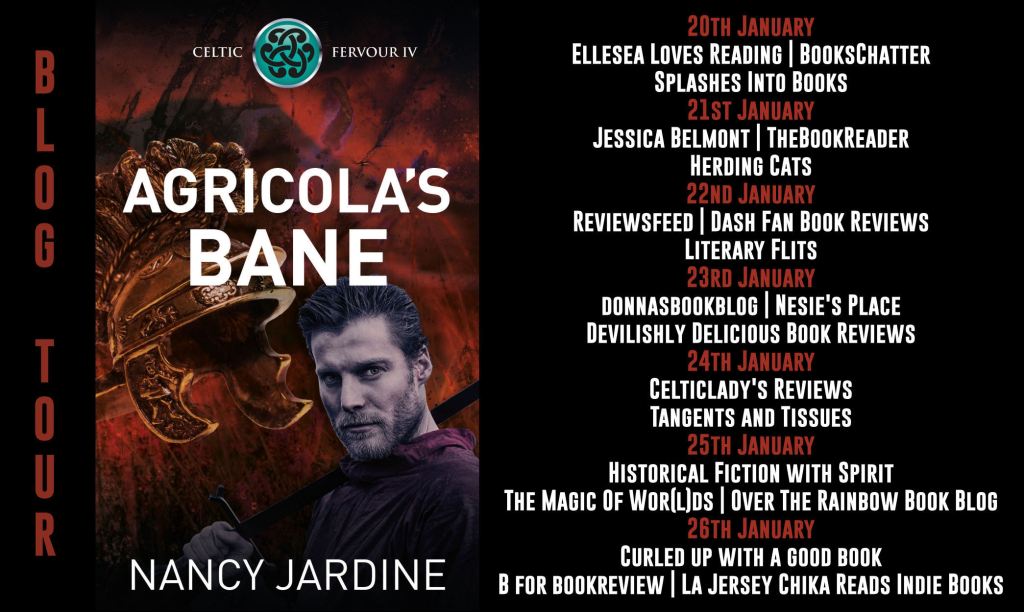
Agricola’s Bane Blog Tour ends with a flourish!

If you enjoy Historical Fiction or you’re curious about the genre, I highly recommend this series. The books should be read in order, in my opinion. I had no qualms about giving this 5 stars!

The Blog Tour arranged for Agricola’s Bane, Book 4 of Nancy Jardine’s Celtic Fervour Historical Saga Series is now over and what a tour it has been!

Four Guest Posts written by the author were very well-received; one really entertaining Author Interview was conducted; four Extracts were posted; and along with general promotional material, a wonderful new clutch of 10 Reviews has been gained for the novel.

Choosing which of the reviews to mention here is a difficult task since they have been highly complimentary of the writing of the series and/or really positive. The variety of comments has been extremely helpful to Nancy as she progresses with the series.  

 A huge thank you goes to all of the participating bloggers and to Rachel Gilbey of Rachel’s Random Resources for organising such a well-executed and professional tour.

Here are a few of the review comments:

“As I’ve come to expect with a Nancy Jardine novel, the narrative is full to the brim with fascinating insights and historical details.”

“Nancy Jardine has done it again with Agricola’s Bane! I am in love with this series and I cannot rave about it enough. This is how Historical Fiction should be done.”

“As ever, I have enjoyed the story from both sides of the battle lines. The Celts and their unyielding determination to remain free of the Roman yoke is inspiring to read. Equally, the complexity of the ever-expanding Roman empire and their struggles in a new challenging climate are really interesting too!”

You can access all the Reviews, Guest Posts, Extracts and Interviews via Nancy’s own blog HERE

The Celtic Fervour Saga Series is available in ebook and paperback formats from Amazon; paperbacks can be ordered from your nearest bookstore.

Enjoy your Ocelot reading!

The Raided Heart – One week until launch, and an early review…

It’s nearly time for the next release from Jennifer C. Wilson – a historical romance, The Raided Heart, set in the world of the border reivers.

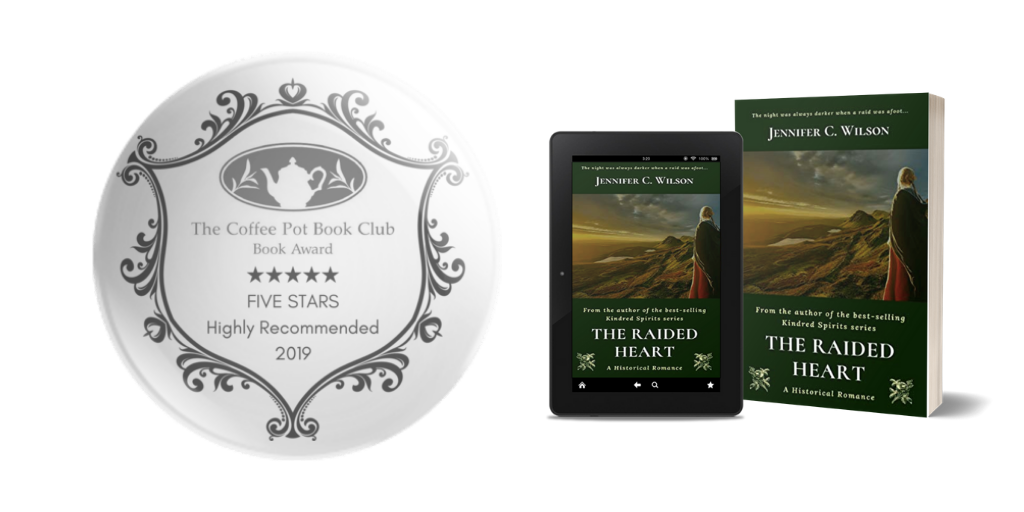
Excitingly, The Raided Heart has already received its first review, along with a coveted Coffee Pot Book Club Award. You can read the full review here, on Mary Anne Yarde’s blog, but we couldn’t resist sharing some snippets, as well as the beautiful award graphic the novel has been awarded…

CoffeePotBookClubBookAward-TRH

Will. Oh, Will. How I adored the hero of this story. It is all so terribly romantic, and Will is just fabulous. I was utterly captivated by Will. He is a marvellous example of what a historical romance hero should be.”

If you are looking for your next tender historical romance, then look no further than The Raided Heart (Historic Hearts, #1) by Jennifer C. Wilson. I, for one, cannot wait to read the second book in what promises to be a fantastic series.”

If that tempts you in, don’t forget to join in the Virtual Launch, on Facebook, on the 15th November!