#Publication day looms…

This post is by Nancy Jardine

Tidy Up Time!
Some people are compulsively tidy, though others are of the ‘It’ll get done soon’ category. I confess to falling into the latter. When I’m at the work-in-progress writing process, my hand written references and notes tend to be a bit of a muddle. I’ve a habit of scribbling on the nearest bit of paper to hand, if something needs to be noted elsewhere later on, in better detail. That means that a home-made map or diagram might have random bits and pieces added which probably only mean something to me.

I’m presently doing my ‘tidy ups’. My contribution for the Ocelot Blog Anthology – Doorways To The Past – is done and dusted, and I’m eagerly awaiting the publishing date of 30th July for that one. I’ve been learning some new book trailer video skills and have created a little promotional video to share with you and the world. You can view the video on the Ocelot Facebook Page HERE.

I’m also at the final stages of completing the e-book and paperback versions of Beathan The Brigante, Book 5 of my Celtic Fervour Saga series (publishing date 20th August 2020). Having finished the manuscript, and having gone through beta reader advice and changes, I really don’t want to find something in my mess of notes that I feel compelled to add to my story, but I always feel duty-bound to re-read the scribbles – just in case.

Very exciting news is that Beathan The Brigante is now available for Kindle Pre- Order from Amazon HERE

I love this stage of the process of getting a story ready for publication. I really enjoy putting together the Historical Context for the book, since not all of my readers are familiar with the complexities of Roman Britain history. I like organising my Glossary sections, adding brief information on things like the gods or goddesses mentioned by my characters – Roman and Celtic. This time around for Book 5, I’ve included a longer section on Roman Army terms that appear in the story, and I’ve added an explanation of the interior of an Ancient Roman fort. Readers who already have some knowledge of Roman Army history will gloss over the sections, but I’ve learned during the process of producing the first four books of the series that some of my readers really appreciate the extra information that helps them understand how my characters operate in their environment.
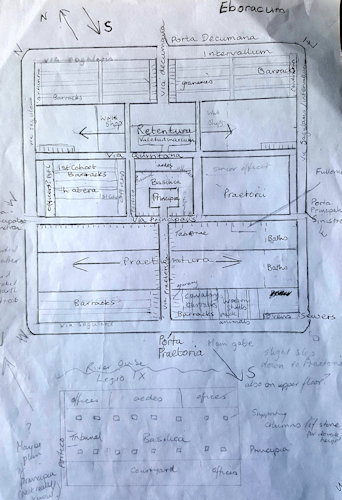
My plan of Eboracum Fortress c. Nancy Jardine

I particularly like creating the map pages for adding to my historical series. After the first book was published, it was a revelation to find a Canadian reviewer had mistakenly thought that the story had mainly taken place in the Caithness area of Scotland. I had written that Brigantia was the northernmost area of Britannia to be invaded by the Ancient Roman legions  in AD 71. The reader had envisaged a current map of Great Britain, and had decided that the northernmost part was Caithness, and thus that was where Brigantia had been. It was then I decided that adding maps to all of my Celtic Fervour novels, even ones created by me, were a necessity rather than an indulgence. I heartily thank that reviewer for pointing out the problem, even if it was done in an inadvertent fashion.
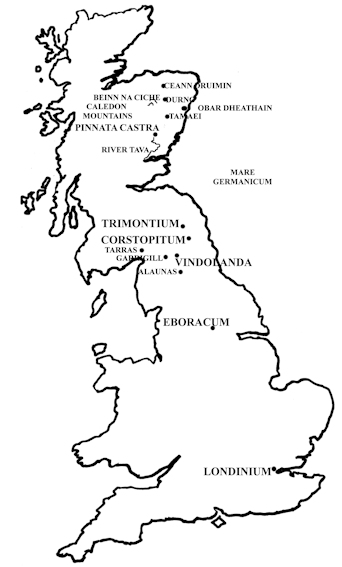
Beathan The Brigante, Britannia Locations c. Nancy Jardine

Making final versions of my maps has become a part of my ‘tidy-up’ routine, and any hand drawn maps and plans, like those shown, are scanned before being added to my stored files. Here’s a sneak preview of what is likely to be one of my final maps for Beathan The Brigante!

What about you? Are you a messy worker who eventually does ‘tidy ups’, in your writing… or in daily life?

And, in case you haven’t seen it yet, here’s the blurb for Beathan The Brigante.

AD 85 Roman Empire

How can young Beathan of Garrigill – held hostage by General Agricola and dragged in chains to Rome – escape and wreak vengeance on his enemies?

Torrin is a strong-minded Brigante warrior-woman who forges her own future. She willingly takes care of him in a time of need, but her own plans are paramount.

Agricola’s career is in tatters. Attempts on his life are plentiful, having lost favour with Emperor Domitian. His gods have abandoned him, though assistance comes from a surprising source.

Will Beathan gain his freedom to return to his kin in Caledonia? Will Torrin be by his side? And how will Agricola survive without the emperor’s benevolence?

Beathan the Brigante is the fifth in the bestselling Celtic Fervour series.

Wishing you an excellent reading week to come!

When The Anarchy reigned…

Let me tell you a bit about a time they called The Anarchy.

No, it’s not the 1970s Punk rock era. The Anarchy, as it became known, was a 12th-century time of civil war and unrest. It’s more impactful than the 1970s, and certainly more deadly.

When King Henry I of England died on 1st December 1135, he left the nobles of the kingdom in a predicament. Having lost his only legitimate son and heir, William the Ætheling, when the White Ship sank off the coast of Normandy in November 1120, Henry had made his barons swear allegiance to his daughter, Matilda. Yes, a woman.

That’s the moment when her cousin, Stephen of Blois, pounced and took ‘her’ throne. He was crowned King of England on 22nd December 1135. Stephen’s brother, also named Henry, a cleric, spread word that the late king had changed his mind on his deathbed and pronounced his support for Stephen. Whether that was true or not is anyone’s guess. But for the population of south-east England, and the nobles who considered Stephen as a good leader, it did the trick. He swiftly gathered support.

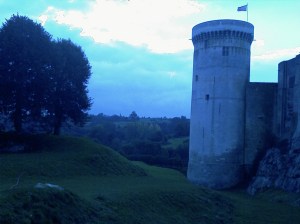
Falaise Castle (c) Cathie Dunn

Matilda, by then 33 years old and pregnant, had been married to the Holy Roman Emperor when she was still a child, and on his death had returned, childless, to her father’s court. Always mindful of his dilemma, Henry married Matilda off to Geoffrey, count of Anjou, 11 years younger than his wife. It wasn’t a love-match, and they lived apart most of the time. But despite their obvious and well-recorded differences, they had three sons.

Tour Marguerite, Argentan, Normandy (c) Cathie Dunn

When Matilda – still in Normandy in December 1135, meeting with her own supporters and considering her position safe – heard of Stephen’s treachery, it was too late. Many English nobles had already sworn their loyalty to her cousin.

The next two to three years were spent building up a following in Anjou and Normandy. Castles were taken, fields scorched, as Geoffrey and Stephen battled for the county. Stephen eventually had to retreat. He also had to focus on rebellions from the Scots, with incursions into northern England, in south Wales and in Cornwall. After a bright start, his luck had begun to turn.

When Matilda’s older half-brother, Robert of Gloucester, rose in support of her claim in 1138, the outcome was clear: civil war. He held Gloucestershire, and many surrounding areas supported him. When he and Matilda arrived in England in 1139, they managed to gain most of their supporters in the West Country. Still, the Pope favoured Stephen, so the Church was equally divided.

But fate favoured neither Matilda nor Stephen. Both won and lost battles. Both gained and lost supporters. The nobles often veered from one to the other, depending on how the wind blew. They became unreliable, their loyalty questionable.

When Stephen was caught during the Battle of Lincoln in 1141, many thought the troubles were over, but they’d only just begun. Stephen’s wife, also called Matilda (or Maud) the rich heiress to the county of Boulogne, rallied his supporters with the help of Flemish mercenaries. The south east was strongly in his favour, and even the Empress Matilda’s attempts to have herself crowned Queen of England failed when Queen Maud’s troops rallied the Londoners, and Matilda was chased out of the city.

When her brother Robert was caught by Queen Maud’s supporters outside Winchester in 1142, he was swapped for the king, and all went back to what it was before. It was a huge blow to Matilda’s cause.

As civil war raged on – both sides attacking castles and strongholds, gaining some and losing others – the population suffered. Crops were burned, towns sacked, and you never knew who was friend or foe. Anarchy reigned supreme.

Robert of Gloucester died in 1147, peacefully, and by 1148, Matilda returned to Normandy, making the county her focus over the coming years. Her eldest son, Henry, however had only just begun to stake his claim in a couple of futile attempts at invading England. When, in 1152, he unexpectedly married Eleanor of Aquitaine, sole heiress of a vast domain that reached south to the Pyrenees (a thorn in the eye of the French king, her divorced husband), many began to take his claims more seriously. His power grew, and his incursions into England grew more and more successful. Eventually, in the Treaty of Winchester in 1153, Stephen agreed to Henry as his successor. However, Stephen would remain king for as long as he lived – which could be years, and even decades – and his surviving son William was rumoured to have Henry assassinated to gain the crown. No one was safe.

Spires of the church of Saint Martin, Argentan, Normandy (c) Cathie Dunn

King Stephen died in October 1154, and the path was finally clear for Henry. He had himself crowned King of England and asserted his rule immediately. Of course, Henry had his fair share of challenges over the decades, but that’s for another time.

~~~

It was around twenty years ago, as a member of an online group called Medieval Enthusiasts, when I first heard about The Anarchy. Ever since, I’ve been fascinated by the chain of events Henry I’s death unleashed. My favourite character is Robert of Gloucester. Had he been legitimate, or had he been allowed to inherit the throne despite his illegitimacy, he could have been King of England, and none of the strife and warfare would likely have happened. He held huge amounts of respect. But, alas, it wasn’t to be.

In my novel, Dark Deceit, my (fictional) protagonist, Sir Geoffrey de Mortagne, a knight, is undersheriff of Gloucestershire – and a spy for the Empress. He walks in royal circles, takes part in battles before having to save a young heiress from herself, and a man he’d known when he was young as a friend, but who was by now an implacable enemy. Dark Deceit begins in 1141, after the Battle of Lincoln.

Geoffrey de Mortagne and the Empress Matilda also feature in a short story in our new collection, Doorways to the Past, released on 30th July 2020.

You can find both titles on Amazon:

Dark Deceit:  mybook.to/Dark_Deceit

Doorways to the Past:  mybook.to/DoorwaystoPast

Cathie’s Amazon author page:  author.to/CathieDunn

Cathie’s website: www.cathiedunn.com

Medieval gate (public domain)

NEW LIFE FOR OLD

Sebastian Faulks, Charlie Higson and Anthony Horowitz have all done it for James Bond.  Alexandra Ripley did it for Scarlett and Rhett.  Jill Paton Walsh did it for Lord Peter Wimsey and Harriet Vane, and PD James did it for the characters from Pride and Prejudice.  There have been numerous attempts to solve Charles Dickens’ unfinished Mystery of Edwin Drood.  And even Thomas the Tank Engine has been given a new lease of life, by the son of his original creator.

So what is it that makes authors want to write new stories centred on existing characters?

In one respect, I think, it’s because once the original author has died, there can be a great sense of regret that there will be no more from the same pen.  So if the authors’ stories and characters are popular, why not give their fans more to enjoy, in the form of sequels, prequels, or simply more adventures?  Or you can even give the original story an alternative ending. More on this later.

You don’t need to be a famous, or even a published, author to take advantage of this very useful literary device.  Using a well-loved character (or set of characters) as the basis for a new story can be an excellent way of dealing with an attack of writer’s block.  Think of a favourite character from a book, a play, or even a poem. Imagine what it might be like to meet that character face to face.  What would you say to them? How do you think they would respond?  Try writing a short dialogue between the two of you, and see where it leads.  You may well find that it gives you a springboard to a whole new story.  No writing is ever wasted, even if it doesn’t end up in the final version.

Or think about how the character behaves in the original work.  If his or her behaviour is unusual, what might have happened in the past to affect actions in the present? Let your imagination run riot – prequels make fascinating stories!

When, more than forty years ago, I saw Franco Zeffirelli’s wonderful film of Romeo & Juliet, I came away thinking:  This is the world’s greatest love story, so why did it all have to go so horribly wrong?  That question has haunted me ever since.

Then, a few years ago, I read one of those lists of Things You Must Do Before You Die. To be honest I found most of them pretty underwhelming, but the one which stood out was Write the book you want to read. And this was what first inspired me to start writing the book I’ve always wanted to read: the version of Romeo & Juliet which has a satisfactory outcome. (I’m not by any means the first person to have attempted to re-write the Bard and reduce the body-count. As far back as 1681, a writer called Nahum Tate produced an alternative version of King Lear, in which Cordelia and Edgar are lovers, the goodies survive, the baddies get their come-uppance, and Lear regains his throne at the end!)

The Ghostly Father

The eventual result was The Ghostly Father – a part-prequel, part-sequel to the original Romeo & Juliet story, told from the point of view of the Friar.  I’ve often wondered why, in Shakespeare’s play, he behaves as he does – and by giving him what I hope is an interesting and thought-provoking backstory, I’ve tried to offer some possible answers.

In addition, the novel explores what might have happened to Shakespeare’s star-crossed lovers if events had taken an alternative course. In the play, the lovers fall victims to a sequence of misfortunes which combine to produce a maddeningly avoidable catastrophe. But what if just one of those unfortunate events had not occurred? What difference could this have made?

Read the book and find out…

Walking on Wild Air: genius loci and the spirit of place

Genius Loci is a Latin term for the deity that rules over a particular place or location. The Oxford Reference dictionary says “every place has its own unique qualities, not only in terms of its physical makeup, but of how it is perceived”. We humans are fond of personifying inanimate objects and places, and it’s an important part of many mythologies.

Whenever I visit somewhere new I’m keen to find out the local name for it, preferably in the native tongue of the place, which can often give a sense of meaning or history. For instance the Isle of Mull (where Walking on Wild Air is set) derives from a Norse word meaning a high flat plateau viewed from the sea. Seamarks like this were useful to the Norse, who went everywhere on the Sea Roads and could navigate by way of familiar landmarks. ‘Vik’, meaning harbour, and ‘Tarbert’, meaning a low place where boats can be portaged from one seaway to another, are also common around the west coast of Scotland for much the same reason.

I know that once upon a time every landmark on Mull, from the most significant to the most intimate, was named and known and cherished by its inhabitants, from Duart (Dubh Ard, the High Dark Place, globally important as the home of the MacLean clan chieftains) to the nameless spring that bubbles on the hill above the house where I used to live. When places are cleared wholesale, and the inhabitants bundled off into cities or encouraged to emigrate, much is lost, and the names of places are not the least of it.

I was tramping in the hills near Dervaig back in 2013, looking for rare moths (or at least their food plants) and wondering about the lost names of every hill and vale, every hummock and streamlet I passed. And then I thought to myself: what if there was something here before the Gaels? Before the Irish settled western Scotland and their language began to diverge into what we now know as Scottish Gaelic. Before the Picts, or whoever was living in these parts before the Gaelic speaking kingdom of Dal Riata arose in the Middle Ages. Before the builders of stone circles and chambered tombs got to work here. Before even the Mesolithic hunter-gatherers created trails around and through the valleys of Mull, and its surrounding islands (they are known from several sites here).

What if there was something that came into being in the fiery chaos of the opening of the Atlantic? Something that arose from and was fed by the constant rain of the Hebrides. Something living. Something strange. What would that be like?

And as strange and wonderful a thought as that was: what then, when people arrive, with their passion for possessiveness and ownership and the naming of things?

And so the idea of the spring came to me, as a locus and source of the strangeness that I wanted to write about, and down ten thousand years the people of the land came to me and gave me their names. And Dougie MacLean was born.

My characters’ names are very important to me. Dougie is short for Dougal, in Gaelic Dubh Gall, the Dark Stranger. That seems pretty appropriate for someone who is not entirely of this world, and whose strangeness becomes ever more apparent as the story unfolds. And the main narrator of Walking on Wild Air, Sushila Mackenzie, has her own naming story. The child of Sri Lankan and Scottish parents, she is named after the daughter of a lovely man I worked with long ago. He told me stories of his daughter, away at university, and how she was the sweetest, kindest, cleverest and most wonderful daughter in the world. How could I not channel that deep-rooted stream of love and affection into my character, especially as she was facing so much pain and tragedy in her life?

In ‘Walking on Wild Air’ the spirit of the spring meets the girl with the broken heart, and who will be healed? Who will be loved? Who will be harmed when two such different worlds collide?

Escape to a place forged not by time, but by memories.

mybook.to/WalkingonWildAir

Come along to my Facebook event 8am-midnight BST on Sunday 28 June 2020, for competitions, conversation and music. Drop in any time to take part. https://www.facebook.com/events/254480262667365/

An announcement, and a birthday offer!

What’s new? Well, this week, for me, quite a lot… Two things in particular, that I’m excited to share with you. 

This week, I’ll be celebrating my birthday in Lockdown, and as I type out this post, I’m very aware that I should have been out in town, celebrating with friends, and having a general giggle about all sort of things. Happily, I am lucky enough to have a very good friend living just a couple of hundred metres from my flat, and I’m hoping, weather-permitting, to pop around to her front garden, and enjoy a slice of cake and glass of fizz, all from a safe distance.

The Raided Heart

I did still want to celebrate though, and so I’m also offering you all a gift from me. For a limited time this week, I’m delighted to be sharing The Raided Heart, free as an ebook! Click here, to be taken to your local Amazon domain, and download your copy today…

And to tempt you in, here’s what reviewers have been saying so far about The Raided Heart:

Exciting, passionate and ultimately the ending keeps the spirit of true love alive.”

The Raided Heart is a Story of forbidden love, a marriage of convenience, heartache, survival and hope.”

A beautiful, realistic romance with dark undertones…”

And the second thing? Well, I’m thrilled to announce my first non-fiction title is now available for pre-order!

JenniferCWilson-ANovelApproach-Cover

A Novel Approach brings together my 2019/20 series of writing workshops, and a talk I delivered during Swanwick 2019. Have you ever thought about writing long-form fiction? In A Novel Approach, I’ll talk you through every step of the process, from generating ideas, creating believable characters, and tackling the ever-thorny issue of ‘showing vs. telling’, all the way through to developing your presence online.

The book itself will launch on the 8th August, and I’ll be sharing more details as we get nearer to the date.

I can’t wait to share this with you!