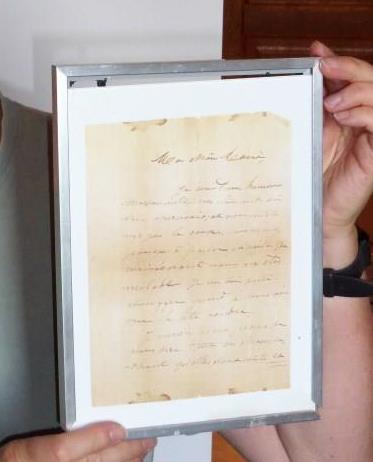
What is it about old letters that come to light later that is so appealing to our imagination? In our age of instant communication via email and social media, letter-writing is a rare practice. Why write someone a letter when you can Skype them instead? But for people a century ago, no other means of staying in contact existed. A letter was a personal thing, even if it took some time for it to arrive or for a reply to come back.
Hello, everyone! I hope you’re all keeping safe and well. We’ve been isolating here in France for 2 1/2 weeks now, but with plenty of books to read and several plots to dive into, I can’t complain about being bored. Fact is, there still aren’t enough hours in the day to get bored!
But today, I’d love to tell our readers a wee bit about historical research, giving the example of my Scottish romance adventure, Highland Arms.
As my readers will know, I love history. I’m fascinated by Scottish history, particularly medieval and Jacobite, English medieval and Tudor, and the Norman conquests across Europe. Add to that the odd foray into the reigns of Charlemagne and Louis XIV… Oh, I could go on!
Anyway, my bookshelves are creaking under the weight of history tomes, but in between those, you’ll find little booklets, their content collated in small Highland or Normandy communities, released by small local printers, which provide inspirations galore. Those are the jewels in the crown, as you’ll discover important little details that make your plot just that little more authentic.
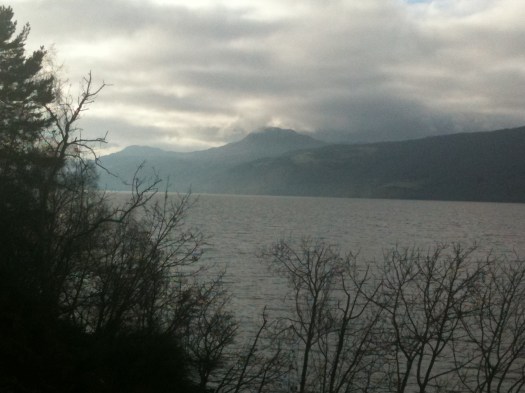
Ballachulish, Loch Linnhe
Highland Arms is set in the Scottish Highlands, near the dramatic hills of Glencoe and the hamlet of Ballachulish, in 1720. Having visited the area many times (and missing it much from a distance), the decision of where to set Highland Arms was an easy one. I loved to create a novel based on the stunning landscapes and troublesome history of my favourite area in Scotland.
Even the ‘Drovers Inn’ mentioned in the novel is based on a real inn: the cosy Clachaig Inn! Visitors of the Scottish Highlands should check it out. (And no, I’m not on commission, sadly!)
Baile a’ Chaolais, Ballachulish’s Gaelic name, means ‘village of the narrows’. It lies at the junction where Loch Leven flows into the much larger Loch Linnhe. The original village lay in what is now North Ballachulish (Highland Arms is set just a couple of miles to the north along the shore of Loch Linnhe), with a settlement in South Ballachulish, now linked by a bridge, established later. I used a local historian’s accounts (one of those useful booklets) for details smuggling activities in the area, which I incorporated into the novel.
Ballachulish is less than a mile from Glencoe village, at the entrance to the Glencoe hill range. The small villages nestle at the bottom of hills, with clouds always hovering low over the mountaintops. It is a highly atmospheric place. Scottish history buffs will know the sad story of the place, the Massacre of Glencoe that befell Clan Macdonald in 1692. You can still sense the desolation today as you travel through the glen. I used the melancholy of the area and incorporated it into a scene where the heroine travels on horseback, listening to tales ofthe (then) fairly recent massacre. The low mist and drizzle, which tends to be the norm in Glencoe, completes the setting.
1720 was a time of great upheaval, only five years after the first major Jacobite rising of the early 18th century. Spies lurked everywhere, and Highlanders didn’t know who they could trust. Clans fought against each other, plotting and seeking their own advantage. Jacobites were lying low, defeated but not giving up. A tale of a ship carrying arms stranded in a northern Highland loch (another fabulous booklet) gave me with the perfect backstory – the hero needed the muskets to start another rebellion. Or so he hoped…
So you see, it’s not necessarily the big, generic historical accounts that provide authors with the best plot ideas; sometimes it’s the little stories, the tales collated and written down by locals, and spotted in a dusty little museum, that make the best storylines.
Keep looking out for them!
About Cathie:
Cathie Dunn writes historical mystery & romance set in Scotland, England and France. A hobby historian, her focus is on medieval and Jacobite eras.
She has four historical novels published:
Highland Arms and A Highland Captive (the Highland Chronicles Tales);
Dark Deceit, the first in The Anarchy Trilogy, set in England & Normandy;
Love Lost in Time, a dual timeline story set in AD 777 and present day in the south of France;
Silent Deception, a romantic Gothic novella set in Victorian Cornwall.
Cathie lives in historic Carcassonne, south-west France, with her husband, a rescue dog and two cats. She currently works on a medieval murder mystery and the sequel to Dark Deceit.
Despite the current situation with coronavirus causing events to be cancelled this year, the end of March is an important one now, for Ricardians. As well as remembering birth, death, marriage, coronation, we can also mark reburial. Five years ago, all eyes were on Leicester, as one of England’s most famous kings was laid to rest for the second time.
And one of our authors was lucky enough to be there for part of it. So, for Jennifer’s first post in our regular series taking place on the Ocelot Press blog, do forgive a bit of indulgent personal nostalgia, and tell you a bit about the beginnings of The Last Plantagenet? …
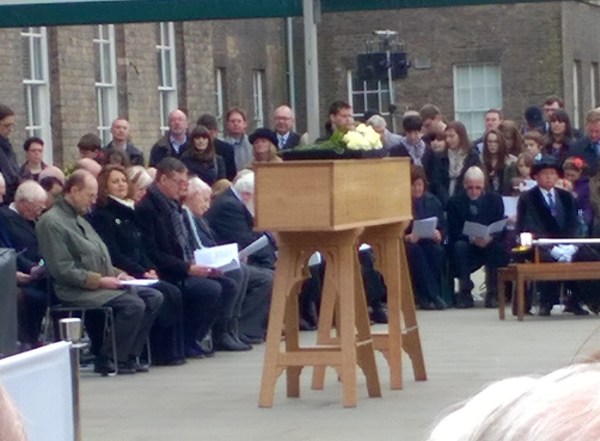
When I put my name into the ballot for a place at one of the events that week in Leicester, I only did it to say I had, to be a part of things, but then, then arrived the envelope… I was going to Compline, the service during which the coffin of Richard III would be brought into the cathedral. And more than that – there was a full Saturday of lectures to attend, and the particularly moving service on Sunday morning at the University of Leicester itself, as they bid farewell to the remains they had studied so carefully, and preserved so well, since they found him in that carpark. Walking down the street behind the hearse for a few moments was a very strange sensation, then heading back to my hotel room and watching the rest of its journey on the BBC news channel.
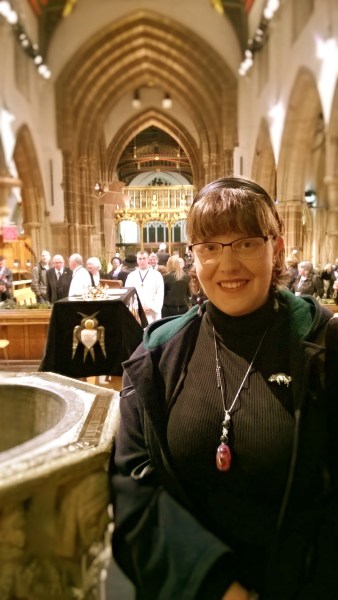
It was a beautiful day all round, and being in Leicester Cathedral to watch the service of Compline is something I shall never forget. There was an odd sense to the day. Yes, it was a funeral, so of course everyone was suitably respectful and sombre in their attitude, but equally, although people had hoped to find King Richard III, it’s not as though anybody was expecting to find him alive, so there was also a sense of celebration to things.
They were even letting people take photos, once the service was over.
That night, after strolling back from the cathedral through the rose-strewn streets of Leicester, I sat in the hotel bar (the smartest-dressed Travelodge clientele I have ever seen!), and pulled out the notebook I’d had in my bag all weekend. I had been playing with an idea for a while, a timeslip novella featuring Richard III, but however hard I tried, couldn’t make it ‘work’. Sitting there, absorbing everything that had happened over the two days, the words flowed. I got my ending, and other than some minor tweaks, the plot was sorted!
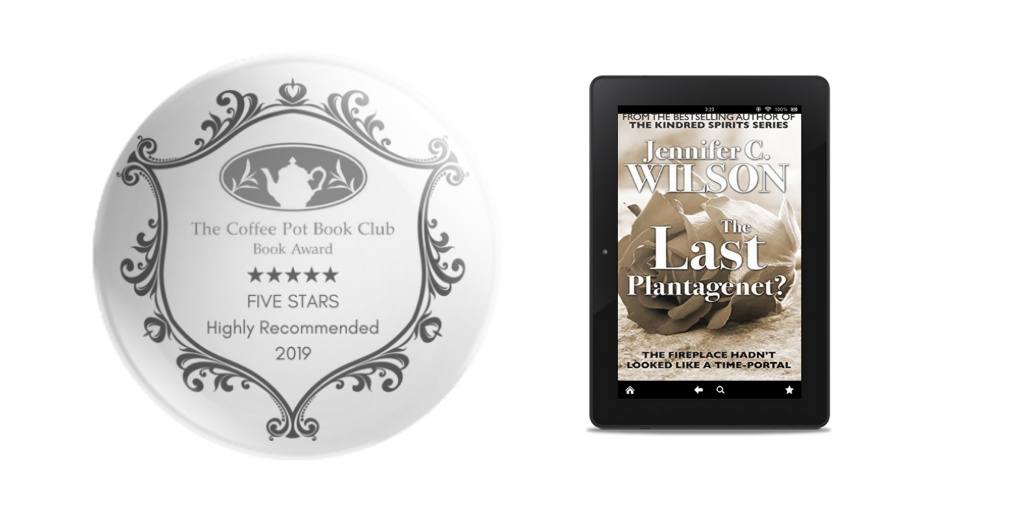
It’s had an exciting journey, first being self-published in October 2017, then joining Ocelot Press in October 2018. And I was thrilled to bits when it was awarded not only a five-star review from the Coffee Pot Book Club Award, but also an Honourable Mention in the blog’s 2019 Book of the Year Awards.
Special Offer!
To celebrate the fifth anniversary of this important event, and the night I can pin-point as the start of when everything starting happening for me, writing-wise (I got back and began editing my Kindred Spirits series too!), The Last Plantagenet? ebook is free to download for a limited time.
I hope you enjoy reading it as much as I enjoyed writing it!
In our continuing series of weekly blog posts, Ocelot author Vanessa Couchman tells us about her research process.
For all historical novelists, research is a vital part of the writing process. Since I took a degree in history, I enjoy the research part enormously. The danger for me is getting so carried away with the research that it threatens to take over the writing!
My first encounter with Shakespeare was at secondary school. Then, as now, studying his works was a non-negotiable part of the English Literature curriculum. Like most stroppy teenagers I found it very hard to understand the plays, and even harder to understand why anyone in their right mind would ever want to read them. Faced with a few hundred pages of solid text written more than three centuries earlier, and in a near-incomprehensible style into the bargain, our collective response was “What on earth is the point of all this?” (That, at any rate, was the gist of our collective response…)
What we stroppy teenagers had totally failed to appreciate, at least at first, is that the plays are not meant to be read in the same way that one would read novels. They were written for performance. It’s only when the text is translated into speech and action (on stage, screen or radio) that it really comes alive – and nowhere is this more apparent than in works which consist entirely of dialogue.
In an attempt to keep us interested, our English teacher allocated the main parts in the play to members of the class, and the key scenes were acted out at the front of the classroom. Our efforts were hardly RSC standard, but they did serve as an early lesson in the basic principle of “show-don’t-tell”. After this, Shakespeare did begin to make some kind of sense.
The play which we studied for O-Level (the equivalent of modern-day GCSE) was Julius Caesar. As I struggled with the idiosyncracies of rhyming couplets and iambic pentameter, little did I realise that more than forty years later this very play would form the backdrop for what was to become my third novel.
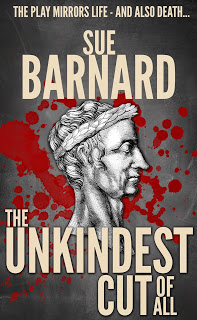
The Unkindest Cut of All is a murder mystery set in a theatre, during an amateur dramatic society’s production of Julius Caesar. The novel’s title is adapted from a quotation from Mark Antony’s crowd-turning funeral speech after Caesar’s death. The play is staged during the week which contains the Ides of March – March 15th, the date on which, according to tradition, Caesar was murdered.






 Ocelot Press