Augustine is Released Today

We’re excited to announce that Vanessa Couchman’s novella, Augustine, is released today on Amazon Kindle under the Ocelot Press imprint.

Augustine is a prequel to her Alouette trilogy, and it’s set against the rolling hills and perched villages of Southwest France in the late 19th-century. Vanessa lives in southern France, not far from where the action takes place, and there’s plenty of period detail woven into the story, drawn from her researches and knowledge of the area. The backdrop is a way of life that lasted for centuries but has now disappeared forever.

In the book, you’ll meet Augustine Bousquet and Joseph Vernhes, who appear again in Overture, Book 1 of the Alouette trilogy. Augustine can be read as a standalone or before Overture.

Chapter 1 of Augustine

Have a sneak peek at Chapter 1 of Vanessa Couchman’s Augustine, coming soon!

Vanessa in France's avatarVanessa Couchman

Augustine is a bitter-sweet romance set against the rolling landscape and hilltop villages of southern France in the late 19th century. This novella is a prequel to the Alouette Trilogy and is currently on pre-order on Amazon Kindle for publication on 30th April 2020. Read Chapter 1 below.

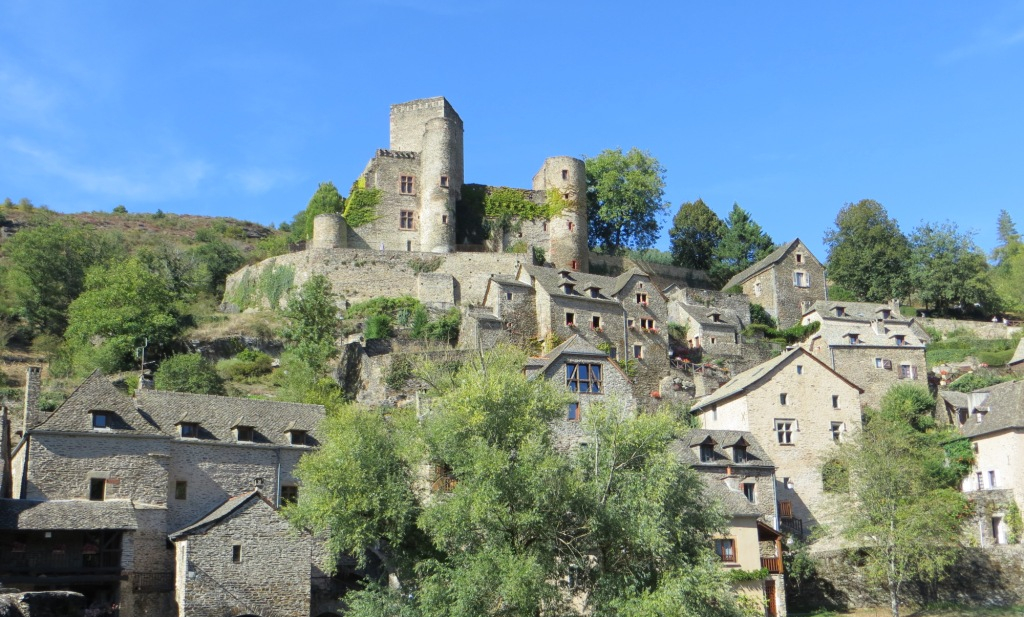
Belcastel, one of the beautiful villages of Southwest France

View original post 2,001 more words

Pizza? Yes, please!

This post is by Nancy Jardine.

Social distancing has recently been making the process of normal food shopping a much longer one than usual, during the current ‘COVID 19 pandemic’ lockdown situation, though this post isn’t about our current global health crisis. It’s about a very ancient issue of feeding people when the supply chain is either interrupted, or needs to be established.

I bake quite often so my larder generally contains baking supplies, though not a sufficient amount for many months. Re- stocking has become an issue, of late, because flour became scarce almost overnight as a result of panic buying and stock-piling, at the end of March. (And we’ll not talk of toilet rolls! … till maybe later 😉)

Being mindful of waste, quantities for bread making, pizza dough, shortbread – and even my breakfast porridge – have been scrutinised more than normal. And in an odd way, this fits in well with my current fiction writing, since I’m often considering what my characters might be eating some 2,000 years ago in Roman Britain.

My usual breakfast is porridge, topped with whatever fresh fruit I need to use up. Many of my Ancient Roman military characters are also eating some form of porridge, though not only for their breakfast. Ancient Greek writing refers to the soldiers of the Roman Empire as being ‘pultiphagonides’ – meaning porridge eaters – and evidence proves that the Roman Army marched effectively on a high carbohydrate, low meat diet. There’s textual evidence of soldiers complaining of being fed too much meat, which might seem strange for some people today.

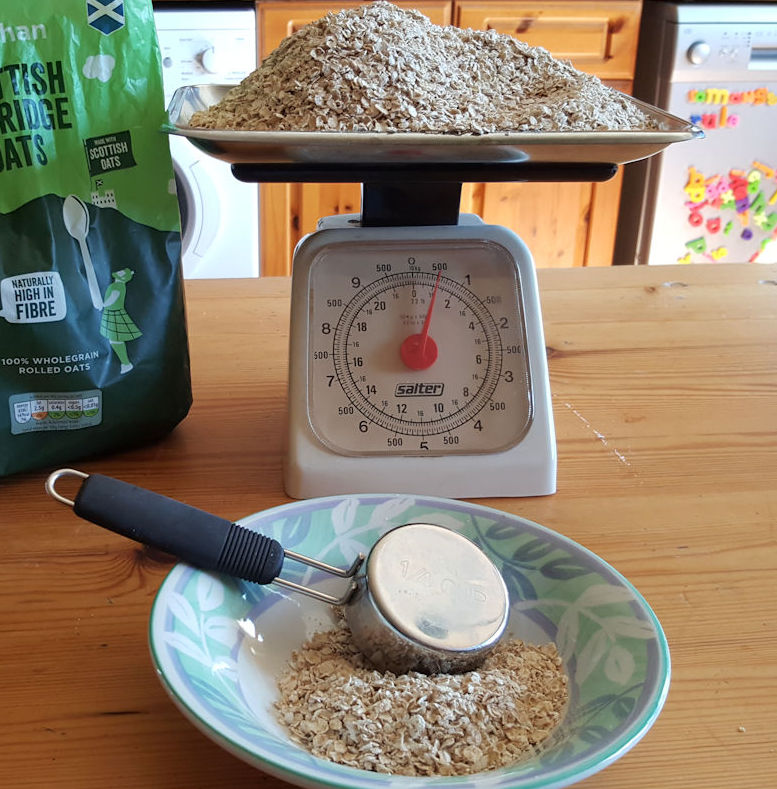
My 1/3 cup usual measure as opposed to 500 g worth of rolled oats.

My porridge, made with a 1/3 of a cup measure of rolled oats (113g/4oz.) to 200 ml of water, sustains me in energy over the morning hours much better than any other cereal. And it worked well for the average Roman soldier, though the estimated quantity of grain each soldier consumed per day is pretty huge in relation to my tiny plateful.

I’ve read a few sources which estimate the typical daily grain ration for a Roman soldier was in the region of 1 – 1 ½ kg, though the amount varied depending on whether on campaign, or barracked in a Roman fort. My scale pan can’t hold much more than the 500 g worth you see in the photo above, but that amount of oats may have been tripled per day and consumed in a limited variety of ways, depending on circumstances.

Roman grain supplies tended to be of hulled wheat. Emmer (triticum dicoccum) and Spelt (triticum spelta) were carried as grain to prevent mould, and then milled using a small portable quern stone when required. Other grains were oats, millet and barley, though the latter was often considered to be a ‘punishment’ ration. (Perhaps because of digestive results and no toilet paper to hand! 😉 ) The grain was cooked as porridge, bread, hard-tack biscuits, and even in a sort of pancake form when mixed with oil or wine – edible, or not, depending on who cooked for the basic contubernium squad of 8 men. Some lucky squad might have had a poor enslaved captive to do this for them.

In Agricola’s Bane, Book 4 of my Celtic Fervour Saga, my Romans are mainly on campaign in A.D. 84, marching northwards in Caledonia. They expect to receive the higher end of the above estimate of grain but, sadly, the general supply chain is somewhat hampered by the successful guerrilla incursions of my local Iron Age tribes. General Agricola’s army consists of upwards of 20, 000 soldiers on the march, so a regular grain supply – sourced from around the Roman Empire and sent to point of need – is critical. The Taexali local tribes grow and rear enough food for their own small communities, but even if Agricola requisitions every last morsel from them, it will only make the tiniest dent in the amount needed for his army. And to add insult to injury, as they say, the cool Scottish climate hasn’t changed much in 2000 years. Wheat doesn’t grow so readily – though barley does very well! (Where’s a dock leaf when you need one? 😉 )

In my current writing, Book 5 of the series, the Romans are mainly fort-based so their daily amount of grain is adjusted and supplemented by some meats when locally sourced, or foraged. My garrison at Vindolanda Roman Fort have reasonable regular supplies arriving at the gates, evidence for this found in the many fabulous Vindolanda tablets that have been excavated.

My writing is set during the very first garrisoning of the Vindolanda site, so the supplies of A.D. 90 may have been a bit less varied than on some of the tablets which were written a little later than that date. There are mentions of pickled and preserved products, olive oil, garum fish sauce, olives, garlic paste. Salt, pepper, various spices and herbs are available to those who can afford them – perhaps the fort commander and the officers? There are seasonal fruits and vegetables mentioned like apples, plums, blackberries, onions, leeks, a kale-type cabbage and various nuts. Common food items listed on the Vindolanda tablets, over the centuries of Roman occupation, are impressive and would not be out of place in a kitchen today.

Vindolanda Tablets- Wikimedia Commons

Last week, I used up the last of my 00 Bread flour to make pizza. My favourite is fully-loaded. Smeared with tomato-based passata, it’s then topped with mushrooms, capsicum peppers, sliced onions, olives, chorizo, artichoke hearts, anchovies, at least one type of cheese and olive oil. YUM. Would the ‘pizza’ eaten by my Ancient Roman soldiers be similar? 

No, to tomatoes since they came to Europe from the Americas long after my Roman era. The Romans did have a kind of sausage, though maybe not quite chorizo. Yes to mushrooms, maybe no to capsicum peppers. Artichokes and anchovies are very possible. Definitely olive oil and maybe a form of cheese. Some of these may have been added to round ‘flat’ breads made at Vindolanda Fort.

My tagine which resembles a clibanus type of cooking pot.

There’s evidence that some Romans cooked using a dish named a clibanus, a flat pottery plate which was covered with a domed lid, similar to my Moroccan tagine in the photograph. Rounds of bread, and flat bread, were baked in these when set upon a fire.

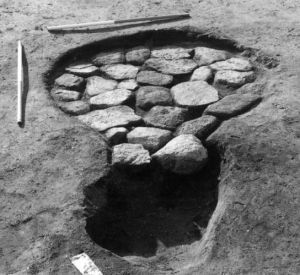
In the village of Kintore where I live, in north-east Scotland, there’s evidence of an Ancient Roman temporary camp used by General Agricola c. A.D. 84. When excavated in 2004, it yielded more than 180 ‘Bi-Partite Roman Bread Ovens’ which were used for the campaigning Romans to make their ‘flatbread and pizza’, with or without a clibanus. The design of the keyhole-shaped ‘fire’ meant that slow cooking could be done on the flat stones adjacent to the burning fire.

Roman Bi-Partite bread oven at Kintore.

Maybe the Roman soldiers in the ‘Deer’s Den’ camp at Kintore were lucky enough to have both ‘pizza’ and porridge for their evening meal, once their temporary camp was built!

You can read about my Romans and the avenging local Celts in the Celtic Fervour Saga Series. (Click to access the novels on Amazon)

Whatever you are reading during the COVID 19 lockdown period- enjoy! And if you have some flour, will you be baking? Tell me about your favourite ‘lockdown’ recipes, please.

Or why not make some Roman bread or Roman flat bread ? I made some bread with spelt flour a few years ago.

Read about it on my own Blog It was delicious- and highly nutritious. Now where will I get spelt today?

Slaìnthe!

VERSE AND WORSE

April is the cruellest month for poets.

It is National Poetry Writing Month (often shortened to NaPoWriMo, or sometimes just NaPo), which takes place every year throughout the month of April.  Each day a prompt appears on the NaPoWriMo website, and poets throughout the world are invited to take up the challenge and post their efforts on their blogs.  The latter probably calls for far more bravery than the actual writing.

I first did NaPo way back in 2013.  Here is one such pathetic effort from that far-off time:

THE BALLADEUSE’S LAMENT

There once was a wannabe poet

whose verses were dire, sad to say.

Then one April, she found NaPoWriMo:

thirty days of a poem a day.


Each morning she looked at the website,

and in the available time

she grappled with form, structure, metre,

enjambement, content and rhyme.


‘Twas the twenty-fifth day of the challenge:

“Write a ballad” the task on the site,

but by bedtime she’d still written nothing

and her muse had retired for the night.


She woke up at three in the morning

with a wondrous idea in her head,

but she could not write down this great epic,

for alas she’d no pen by her bed.


Then sleep once again overcame her

and hijacked her poor addled brain.

On waking, her great inspiration

had vanished like snow in the rain.


And if this sad tale has a moral,

it is this: always be on your guard,

for if you let go of the moment

you’ll never succeed as a bard.


My original blog, which you can find here, even owes its title to poetry.  Fans of Robert Browning (I’m sure there must be some of you out there) will probably recognise the sly reference to one of his best-known works.  Here is an unashamed spoof of one of his others:

THE PIED PIPER OF LIMERICK

A town in a faraway nation

had a terrible rat infestation,

about which the mayor

appeared not to care

(to the townspeople’s rage and frustration).


The plague had become so acute

that the townsfolk were quite resolute:

“We must do something here!”

Then who should appear

but a man in a weird coloured suit.


“I see you’ve a problem,” said he.

“Now listen: if I guarantee

to dispose of your rats,

give me one thousand crowns.  That’s

my fee.”  Said the mayor, “I agree.”


The stranger, with fingers a-quiver,

piped a tune which made all the folk shiver.

But the hypnotic air

made the rats leave their lair

and leap to their deaths in the river.


Oh, great was the joy in the town!

Then the piper said “My thousand crowns?”

When the mayor, looking shifty,

just offered him fifty,

the piper’s smile turned to a frown.


He glared, strode out into the square,

and, raising his pipe in the air,

played another refrain.

The town’s children came

and followed him – Heaven knows where.


The mayor’s desperate pleas went in vain,

for the children were ne’er seen again.

So the lesson inferred

is “You must keep your word”

and to think otherwise is insane!


And finally, in homage to Shakespeare, here are two limericks based on Romeo & Juliet and Julius Caesar (which inspired my Ocelot novels The Ghostly Father and The Unkindest Cut of All respectively).  My long-term aim is to produce a limerick for each of the Bard’s plays, but that is still very much a work in progress.


ROMEO & JULIET

Two households, one ongoing row;

sprogs meet and exchange true love vow.

Next day they are wed;

three days later, both dead.

Their tale makes me weep, even now.


JULIUS CAESAR

A soothsayer (very astute)

tries to warn of impending dispute.

But though told to beware

Caesar claims not to care,

then he’s killed by a backstabbing Brute.


If you’re still with me, well done.  Go and pour yourself a stiff drink.  

Augustine: Cover Reveal and Launch Details

We’re thrilled to announce Vanessa Couchman’s latest book, Augustine, a prequel novella to the Alouette trilogy.

Vanessa in France's avatarVanessa Couchman

On 30th April, I’m publishing a prequel to the Alouette trilogy, Augustine. This is a novella (about half the length of a standard novel), set in rural Southwest France in the 1880s. It tells the story of Augustine and Joseph, who appear in Book 1 of the trilogy, Overture.

My fab cover designer, JD Smith, has come up with the goods yet again. The cover fits the story really well and is just what I wanted.

Here’s the blurb:

Love conquers all. Or does it?

Rural France 1880. Augustine is not conventionally pretty and fears that she may never marry. Joseph rents his land and dreams of owning a farm one day. But without a wife and children, he lacks the help he needs.

When Joseph saves Augustine from a drunkard at a dance, they are immediately attracted to each other. They meet again, and the attraction…

View original post 141 more words